ASUS RTX 5060 TUF OC Review: Benchmark Performance Tested
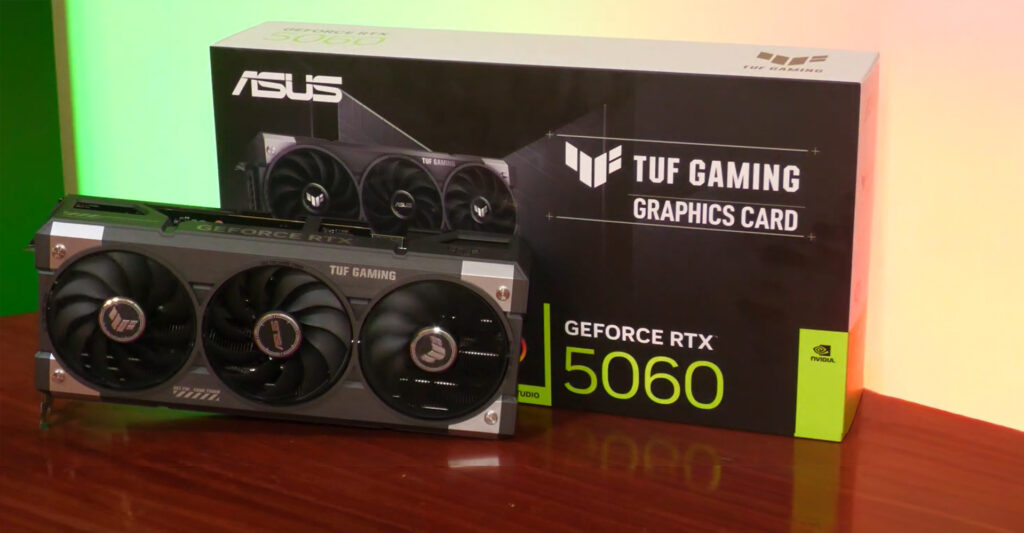
The RTX 5060 TUF OC has finally arrived, but not without drama. NVIDIA’s controversial approach to review access left independent reviewers scrambling for test samples. Ironically, the card that many expected to be widely available came in late, limited, and wrapped in marketing restrictions.
Still, thanks to ASUS, we finally have a proper look at this elusive GPU. Positioned as the entry-level Blackwell architecture card, the RTX 5060 TUF OC promises better efficiency, faster GDDR7 memory, and improved RT/Tensor cores all while keeping the MSRP at $299 USD.
JayzTwoCents on YouTube breaks down what’s new, comparing the RTX 5060 and the older 4060. Specs are one thing, but do they really make this card worth it in 2025’s competitive gaming scene? Let’s see where this card stands.
Technical Specifications
| Feature | RTX 4060 | RTX 5060 |
|---|---|---|
| Architecture | Ada Lovelace | Blackwell |
| Process | 5nm | 5nm |
| CUDA Cores | 3,072 | 3,840 |
| Tensor Cores | 96 | 120 |
| RT Cores | 24 | 30 |
| VRAM | 8 GB GDDR6 | 8 GB GDDR7 |
| Bus Width | 128-bit | 128-bit |
| Bandwidth | 272 GB/s | 448 GB/s |
| TDP | 145W | 145W |
| MSRP | $299 | $299 |
Despite its generational improvements notably in memory bandwidth and core count the 8GB VRAM limitation remains a sore point. For 1080p gaming, that’s fine. For 1440p and beyond, however, it becomes the biggest bottleneck.
Architectural Overview
The RTX 5060 TUF OC runs on the GB206 Blackwell GPU, boasting 21.9 billion transistors up from the RTX 4060’s 18.9 billion.
While NVIDIA calls it a new generation, the truth is, this feels more like a half-step refresh rather than a full generational leap.
What saves it is GDDR7 memory, which doubles bandwidth and gives a noticeable edge in ray tracing and DLSS supported titles.
Still, with just 8GB VRAM, the card struggles in high-texture games and modern AAA titles at higher resolutions.
Gaming Performance
In testing, the RTX 5060 TUF OC showed a clear improvement over the previous generation. At 1080p, it delivered smooth and stable performance, consistently surpassing 90 FPS in most modern titles both competitive and AAA games. At 1440p, performance remains strong, but the 8GB VRAM starts to show its limits in texture-heavy games like Hogwarts Legacy and Starfield. The average 14–15% performance uplift compared to the RTX 4060 is noticeable, especially in ray-traced titles where the card benefits from enhanced cores and faster GDDR7 memory. However, 4K gaming remains out of reach, with frame rates often dropping below 40 FPS in demanding titles.
Overall, the RTX 5060 TUF OC stands out as an excellent 1080p GPU, offering great efficiency and low power draw but it’s still constrained by its limited memory, which could impact its long-term relevance in future games.
| Category | Average Performance | Notes |
|---|---|---|
| 1080p Gaming | Excellent (90–150 FPS) | Ideal for competitive and AAA gaming |
| 1440p Gaming | Good (55–90 FPS) | May require settings tweaks in heavier titles |
| 4K Gaming | Weak (25–40 FPS) | Not suitable for this resolution |
| Ray Tracing | Very Good | ~20% better than RTX 4060 |
| Power Efficiency | Excellent | Low consumption and minimal heat output |
Pricing and Value
While NVIDIA advertises a $299 MSRP, actual market pricing tells a different story.
At launch, only the ASUS Prime model was found at MSRP with others like the TUF OC, MSI Gaming, and ZOTAC AMP ranging between $340 and $410.
That’s up to a $110 premium for a minimal factory overclock offering little real-world benefit.
As the reviewer pointed out:
“I could not imagine spending more than $299 on this card.”
At this pricing, even AMD’s Radeon RX 7600 XT (16GB) offers significantly better longevity due to its double VRAM capacity.
Power Efficiency
The RTX 5060 draws 145 watts, with NVIDIA recommending only a 300W PSU extremely power efficient for modern standards. This makes it an excellent option for small-form-factor PCs and budget builds.
However, efficiency alone doesn’t justify limited memory and inflated pricing.
Final Review
The ASUS RTX 5060 TUF OC delivers exactly what you’d expect from a well-balanced midrange GPU: excellent power efficiency, strong 1080p performance, and high build quality. It runs smoothly and stays cool under load, with the TUF cooling system maintaining impressively low temperatures and minimal noise even during long gaming sessions.
At 1080p, the card performs exceptionally well, providing smooth gameplay in most modern titles and making great use of DLSS 3 and Frame Generation. Moving to 1440p, performance remains solid, though the 8GB VRAM begins to show its limits in newer, texture-heavy games. As for 4K, the RTX 5060 simply isn’t built for it, even with upscaling enabled.
The improvements over the RTX 4060 are noticeable but modest, averaging around a 15% performance gain with better ray tracing thanks to GDDR7 memory and enhanced cores. However, this advantage doesn’t fully justify the inflated launch prices above the official $299 MSRP.
In the end, the RTX 5060 TUF OC stands out for its cool operation, impressive efficiency, and excellent 1080p gaming performance, but it remains limited by NVIDIA’s choice to stick with 8GB of VRAM. It’s a smart purchase only at its official MSRP a capable and balanced card for its class, but not the major upgrade many gamers were hoping for.